


January 10, 2022
BASF: Success in livestock production with the science of sustainable feed
An eFeedLink Exclusive Talk
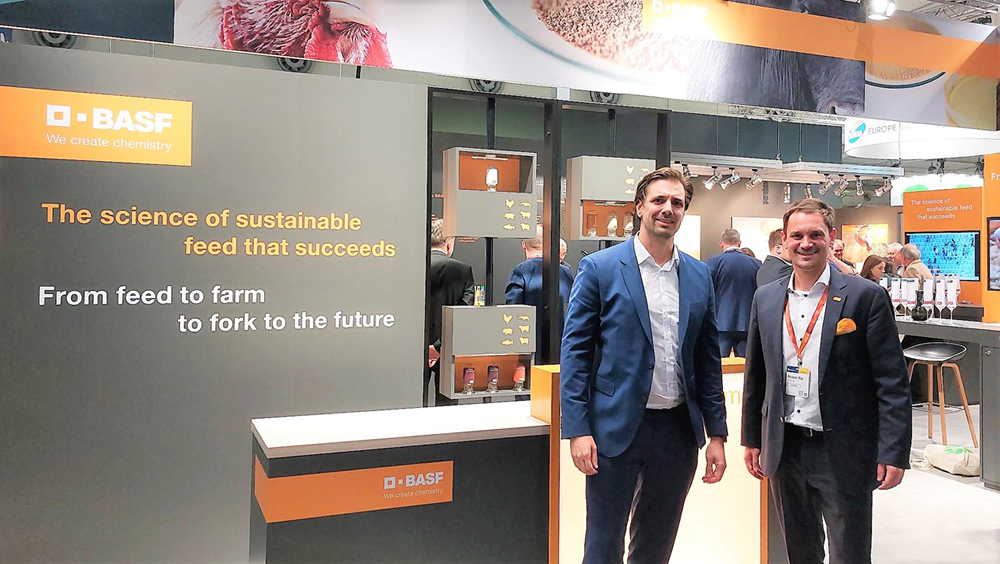
BASF's participation at last year's EuroTier show in Hanover, Germany, underscored its "strong heritage and commitment to the animal nutrition industry," says Manuel Rez, BASF's Director of Global Product Management (Performance Ingredients) and Marketing (Animal Nutrition).
For more than 50 years, this commitment entails creating "feed ingredients like vitamins and enzymes on a scientific basis, conducting several feeding trials to confirm their effects and developing application concepts," he notes.
In that context, Dr. Sven K. Weber, BASF's Vice President Feed of Enzymes and Feed Performance Ingredients, together with Rez, explains what makes BASF Animal Nutrition stand out for its "science of sustainable feed that succeeds".
How will BASF solutions support and help achieve positive outcomes in livestock and feed productions, such as in the areas of sustainability and better feed cost management?
Dr. Sven K. Weber: One important factor of our science-based, sustainable solutions approach is a more efficient use of resources, with fewer inputs for the same or higher output. Feed still accounts for 50-70% of the total costs in animal production. Improving nutrient utilisation and converting feed into food more effectively thus remains a key lever for reducing costs and return on investment (ROI) in livestock farming.
BASF's feed ingredients are therefore a proven tool. Our enzymes, for example, allow more efficient use of resources, with fewer inputs for the same or higher output. By improving feed conversion rates, BASF's feed ingredients can help producers to become more efficient and resilient in the face of current economic challenges. This way, the difficult market environment also brings about an opportunity for the animal nutrition industry as it can accelerate the development towards more sustainable production of animal protein.
We also understand that BASF currently has four enzyme-based products in its portfolio, namely, those based on phytase, xylanase, glucanase and ß-mannanase. Please tell us more about these products and the roles they will play in the company's animal nutrition range.
Dr. Sven K. Weber: As a pioneer in enzymes for more than 30 years, BASF builds on its strengths and distinct know-how as a feed enzymes specialist. BASF's enzyme technology includes enzyme identification, engineering, registration, scale-up, production and formulation.
Our narrative of enzymes gives customers a clear orientation on what they can expect from us: "Proven and effective enzymes from BASF - The science of making more from less". We will build on this efficiency-enhancing effect of our feed enzymes and expand it with enzyme innovations.
Furthermore, we invest significantly in our production assets. We have, for instance, increased the capacity of our main enzymes plant in Germany. The larger production capacity enables us to meet the growing global demand from customers for a reliable, high-quality supply of our feed enzymes, Natuphos®E (phytase), Natugrain®TS (xylanase and glucanase) and the recently launched Natupulse®TS (mannanase).
In addition to the new product launches, we also continuously work on practical improvements to our feed enzymes portfolio. We were able to further increase the thermostability of our Natuphos® E powder and granule formulations. We also offer combi-products with phytase, xylanase and glucanase with guaranteed enzyme activities. Our large enzymes portfolio stands out and thus offers the right product for almost every possible application.
Additionally, we have recently expanded our partnership with Cargill by adding R&D capabilities and new markets to our existing feed enzymes distribution agreements. By combining our capabilities, we can deliver more enzyme products and solutions, generating distinctive value for the animal nutrition industry even faster.
Please share with us about the products that BASF featured at EuroTier 2022.
Manuel Rez: For our customers and visitors, we put BASF's two core pillars of animal nutrition as the focus of our booth: vitamins and carotenoids as well as feed enzymes and feed performance ingredients.
These products include our innovative feed enzyme Natupulse® TS, a non-starch polysaccharide (NSP) enzyme which decreases digesta viscosity, increases the digestibility of feed and ensures a more sustainable production.
Other products featured at our booth are our digital solutions. Of particular interest are our trinamiX handheld near-infrared spectroscopy (NIR) device and Opteinics™ software tool.
Talking about digital solutions, what we can expect from BASF concerning the development and introduction of data-based, digital applications for livestock or feed productions in the near future and coming years?
Manuel Rez: BASF already offers a number of proven digital solutions, complementing our feed ingredients offer. We constantly add new features and improve our digital solutions offering.
Our handheld NIR solution from trinamiX delivers value where it matters most: in the field. Farmers, feed mills, integrators and consultants are now equipped with a powerful handheld device and app for on-the-spot analysis of finished feed, feed ingredients and forage.
With Opteinics™, BASF has developed a digital solution to analyse and minimise the environmental impact of animal protein with a focus on animal feed production which helps to identify opportunities for improvement, without compromising cost and nutrition.
There is also Cloudfarms, the first fully cloud-based swine management system for highly productive and efficient livestock farming.
The insights gained through digital solutions by analysing and linking data along the value chain help our customers to increase efficiency and make data-driven decisions.
A multitude of challenges has seemingly created a tougher situation for livestock and feed producers. In this difficult period, how will BASF approach animal nutrition in addressing some of these global issues? What do you foresee for the animal nutrition market going forward?
Dr. Sven K. Weber: This challenging environment puts pressure on all players along the value chain to increasingly build on products and technologies to unlock production efficiencies. It is more important than ever before to improve nutrient utilisation and effective conversion of feed into food in order to reduce costs in livestock farming. As such, enzymes would allow more efficient use of resources, with fewer inputs for the same or higher output.
Additionally, we foresee at least a temporary shift to white meat. As the demand for our additives in poultry is, for instance, higher than for ruminants, we expect that demand for our additives is less impacted than overall compound feed production. While we expect a challenging 2023, our mid-term outlook for the industry in general and, particularly, for the demand for feed additives is more promising.
Overall, BASF remains fully committed to offering the animal livestock industry "the science of sustainable feed that succeeds". This means we will continue bringing products to the market that we are convinced are beneficial. At the same time, we want to ensure that our customers can use them successfully.
- Terry Tan,eFeedLink


