January 4, 2020
Where have the big Chinook salmon gone? Eaten by killer whales, says new study
Large, old Chinook salmon have mostly disappeared from the US West Coast. To find out what could be the cause, a joint team from the University of Washington (UW) and the National Oceanic and Atmospheric Administration (NOAA) made a study, and their findings were published Dec. 16 in the Proceedings of the National Academy of Sciences journal.
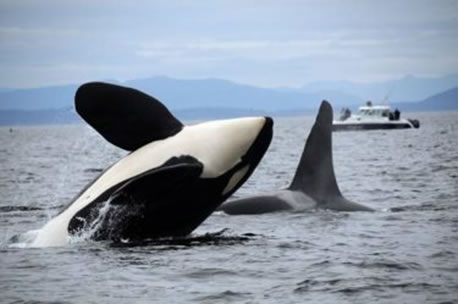
Their main finding points to killer whales as the culprit. Fish-eating orca populations that live along the coast, called "residents", are in fact growing, and these killer whales have an insatiable appetite particularly for large Chinook salmon.
"We have two protected species, resident killer whales and Chinook salmon, and we are trying to increase abundances of both-yet they are interacting as predator and prey", said lead author Jan Ohlberger, a research scientist at the UW School of Aquatic and Fishery Sciences, as quoted in a UW news release.
"Killer whales don't show a lot of interest in Chinook until they reach a certain size, and then they focus intensely on those individuals", she added.
The researchers said resident orcas usually don't go for Chinook until they reach about 25 inches in length, and they prefer fish that are over 30 inches long.
Each year these top ocean predators consume more than 2.5 million adult Chinook salmon along the West Coast, according to the study.
The research team analysed nearly 40 years of data from hatchery and wild Chinook populations from California to Alaska. They analysed whether fishing pressure played a role in why the biggest Chinook have disappeared, as well as considered other factors like changing ocean conditions, and feeding from other marine mammals such as sea lions and seals.