


Phytobiotics: Positive Gut Feelings - A Glimpse into Welfare & Broiler Nutrition with Isoquinoline Alkaloids
In modern poultry production, success and profitability are closely linked to both physiological and welfare parameters. Environmental and nutritional inputs influence physiological mechanisms, ultimately affecting live performance and slaughter outcomes.
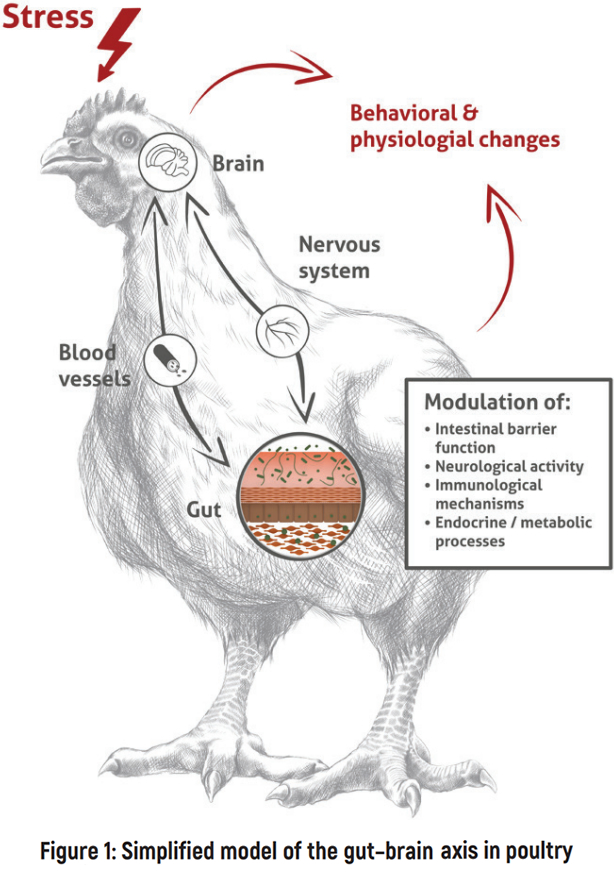
A key aspect in this context is the bidirectional exchange through the gut–brain axis (GBA), which leads to different levels of stress resilience in the animal. At present, efforts are being made to better understand this tight connection between processes in the gut and their direct or indirect effects on other parts of the body. The GBA can be split into different areas working hand in hand.
Directly responsible for stress response is the hypothalamic–pituitary–adrenal axis (HPAA). HPAA is working with neuroendocrine messengers such as glucocorticoids, whereof cortisol in mammals and corticosterone in rodents and avian species is one well-known candidate. The microbiota–GBA specifically focuses on the role of gut microbiota, which becomes increasingly crucial for modulating the immune system, stress responses, and general neurotransmitter generation, as well as animal behaviour.
Furthermore, the enteric, central, and autonomous nervous systems, as well as the immune system and endocrine communication mechanisms, play an important part in the tight regulation of the GBA (Figure 1).
From lab to barn
To translate theory and laboratory conditions into practical livestock applications, feed additives are a promising option to reach GBA either indirectly via alterations of the microbiome, direct interaction with the gut wall, or affecting through the absorption route.
The gained effect can be measured through various parameters playing an important role in the GBA complex system – for example, besides a much longer list, acute phase proteins, cytokines, serotonin, and specific amino acids, microbiome alterations, and responding metabolites like shortchain fatty acids, tight junction proteins, or transepithelial resistance can be selected.
To gain a deeper understanding of feed additives acting via the GBA and their related effects on stress, a trial was conducted at the University of Warmia and Mazury (UWM), Poland. The study aimed to evaluate a wellestablished phytogenic feed additive, based on a standardised blend of isoquinoline alkaloids (IQs), under institute conditions. Besides performance data, research was also done on stress-related markers.
IQs are known to have a positive impact on different situations of stress, like transportation, heat-stress, or parturition, providing improved performance along with lower expressions of inflammation and stress markers, microbiome shifting effects towards more beneficial bacteria groups, and reduced intestinal permeability.
The trial included 384 one-day-old male Ross 308 broilers, divided into two treatment groups: C) Control, IQ) 100 mg IQs*/t feed (*Sangrovit WS) with application from day (d) 1 up to d28. Trial observations lasted till d35. Each treatment included 12 replications with 16 birds per replication. Birds were reared in floor pens (0.11 m2 per bird) and fresh wood shavings as bedding. The room temperature was gradually reduced from approximately 33°C (d1) to about 20°C (d35). Relative humidity was in the range of 60% to 70%.
Commercial mash diets (I. starter d0-14 and II. grower d15-35) were based on corn, wheat, and soybean meal. Body weight and feed consumption were recorded on d1, d7, d14, d28, and d35, and mortality was documented daily. Serum corticosterone (DetectX corticosterone immunoassay kit) and ovotransferrin (Abcam's ovotransferrin chicken ELISA kit) were measured on d28 in two broilers per pen. Parameters were analysed using a one-way ANOVA general linear model function.
Key points
Final body weight at d35 and average daily weight gain significantly increased in the IQ treatment compared to the control group (p<0.05; Figure 2). Average daily feed intake and feed conversion ratio showed improved levels in the IQ groups, but did not achieve significance. Mortality levels (d1-d35) were at 3.65 % (C) and 2.60 % (IQ). Overall effectiveness improved, as reflected by a significantly higher European Production Efficiency Factor (Figure 3). The serum corticosterone level measured at d28 was significantly reduced in the IQ group (p<0.01), and serum ovotransferrin showed an even stronger, highly significant decrease (p<0.001) in the IQ treatment compared to birds of the control group (Figure 4).
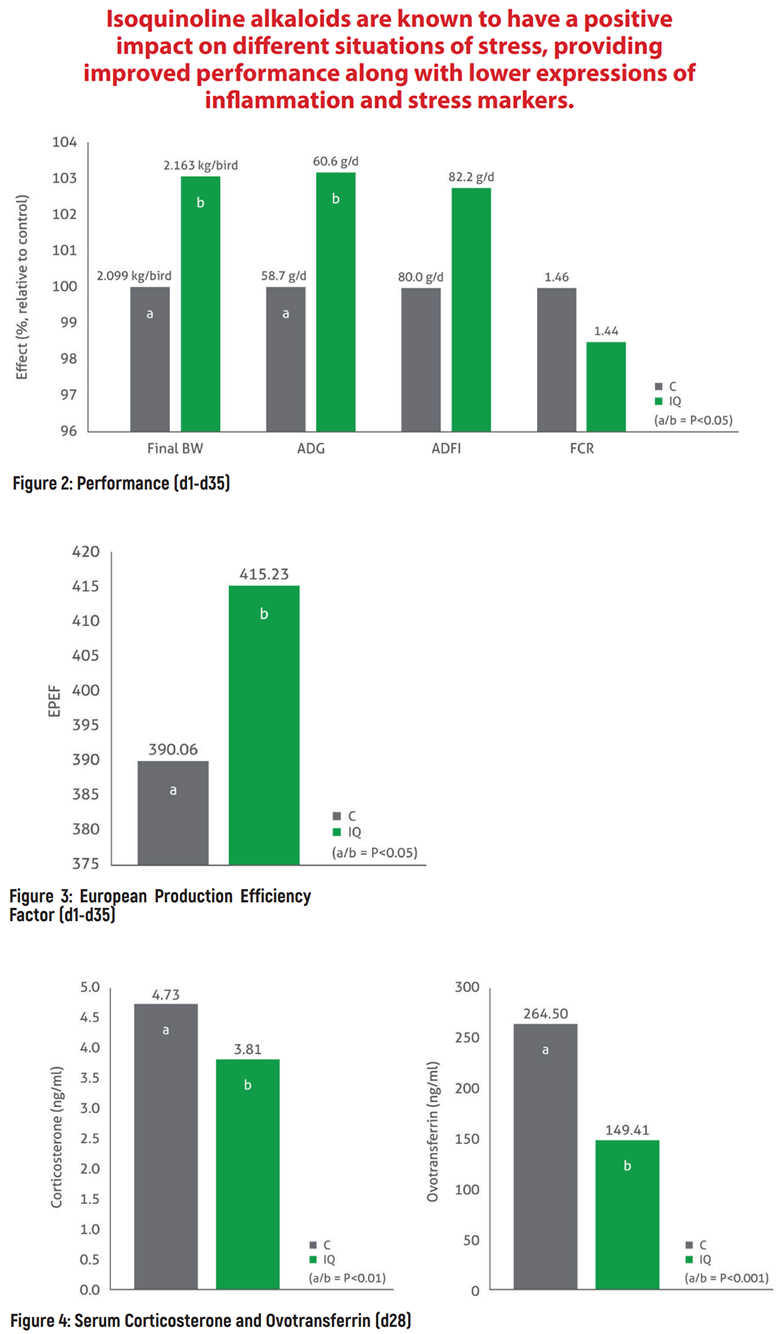
The results of the trial above are consistent with previous findings. Besides the increase in productivity, the reduced detection of corticosterone may also have long-term effects on various other fields, often being connected via the GBA. For example, glucocorticoids are known to alter the virulence and growth of bacteria like Salmonella, leading to the breakdown of lipids and proteins, including muscle atrophy, to increase glycogenolysis and to compromise immunity. Like corticosterone concentrations, the acute phase protein ovotransferrin is often related to disorders in broiler welfare and performance connected to inflammation or heat, microbial stress, or too high stocking density.
Conclusion
Managing animal welfare and productivity through the GBA with selected feed or water components provides an additional tool for solving problems and improving livestock. Glucocorticoids, together with other parameters, provide insights into why animals perform well or why efficiency remains below desired levels. For future production of resilient birds, it will be essential to monitor and better understand stress responses mediated through the GBA and how to find modulating strategies in this network.
A list of references is available from the author upon request.
Isoquinoline alkaloids are known to have a positive impact on different situations of stress, providing improved performance along with lower expressions of inflammation and stress markers.


