August 24, 2005
ASA Weekly: FDA considering allowing health claims on soy products; Senator Durbin to request drought aid
FDA considering allowing health claims on soy products
The Food and Drug Administration (FDA) is considering a petition to grant soy products a qualified health claim for possible prevention of breast, colon and prostate cancers.
Unlike full-fledged health claims, qualified health claims are based on emerging research that suggests, but doesn't prove, a health benefit. Nuts, olive oil and omega-3 fatty acids are some of the foods and dietary supplements that have received qualified claims in recent years.
Soy protein has already earned one full-fledged FDA health claim for heart benefits.
Since 1999, low-fat, low-cholesterol products containing at least 6.25 grams of soy protein per serving¡ªequal to about a half cup of tofu or a cup of soy milk¡ªcan carry a label that says, "Diets low in saturated fat and cholesterol that include 25 grams of soy protein a day may reduce the risk of heart disease."
Since that claim went into effect, consumption of soy protein has more than doubled in the US. If the new health claim is granted and soy consumption again doubles, industry sources project that US soy intake could reach 4.5 grams a day.
Senator Durbin to request drought aid
Senator Dick Durbin (D-Ill.) said recently that when the Senate returns in September, he will seek disaster aid to help farmers in the state hit hard by drought this season.
Durbin said that the options he will pursue include both a disaster program and the possible addition of supplemental disaster relief to the agriculture appropriation bill.
"The situation in Illinois is so bad from top to bottom, it's something I will definitely work for," Durbin said after looking at crops near McLean, Illinois.
USDA last month declared all but one of Illinois' counties agricultural disaster areas, making producers eligible for low-interest loans.
Drought hampers river transportation; New locks to be considered by Congress
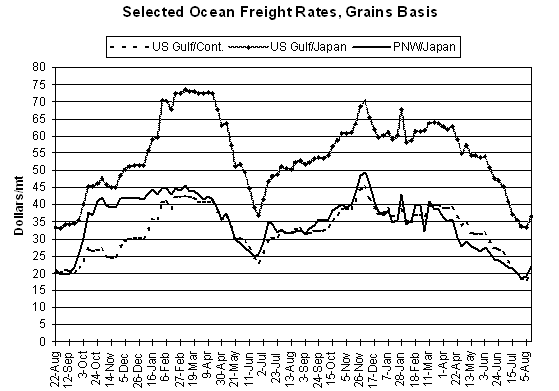
As the worst drought since 1988 stresses crops across parts of the Midwest, low-water levels are turning parts of the Mississippi and Ohio rivers into virtual sandbars, causing towboats and barges to run aground and thus delaying shipments of some agricultural goods.
The delays also are threatening construction projects throughout the region and increasing transportation costs to some international markets, commodity analysts and barge-shipping officials said.
Recent rain has eased crop progress in some areas. "These rains right now will help the soybean crop," said Dave Lehman, managing director of commodities at the Chicago Board of Trade.
For the 2005-06 crop year starting in September, the soybean output in the US is expected to be 75.96 million tonnes, according to the USDA's latest forecast Aug 12. Average yield is estimated at 2.6 tonnes a hectare, compared with last year's 2.86 tonnes a hectare.
Meanwhile, after decades of controversy, study and debate, the question of what to do about the navigational logjams on the Illinois and Mississippi Rivers is now in the hands of the Senate.
At issue is whether the US$3.6-billion cost to speed up shipping with seven new locks while ecologically restoring the two rivers is justified. The proposed project would be one of the costliest waterway improvements in US history and is generating waves of arguments across the Midwest's two major rivers and in the halls of Washington.
Despite mounting opposition, the House in mid-July voted 406-14 to approve the plan. The Senate is expected to tackle the issue when it reconvenes this year. Besides US$1.8 billion for new locks, the plan includes about US$1.58 billion for ecological restoration of both rivers in the next 15 years and US$235 million of upgrades to upstream locks.
The rivers have historically been the transportation backbone for shipping soybeans, grain, corn and other Midwest commodities worldwide.
But expansion critics, including some environmentalists and taxpayer groups, say building new locks is a waste of federal money. Barge traffic is down by over a third in the last 15 years, thanks to burgeoning rail and truck transport and competition overseas from South American exports, they say.
US & South America Soybean/Products Balance
|
US |
Argentina |
Brazil | |||||||
|
Actual |
Estimate |
Proj. |
Actual |
Estimate |
Proj. |
Actual |
Estimate |
Proj. | |
|
2003-04 |
2004-05 |
2005-06 |
2004-05 |
2005-06 |
2006-07 |
2004-05 |
2005-06 |
2006-07 | |
|
Soybeans |
thousand tonnes | ||||||||
|
Carryin |
4,853 |
3,059 |
7,886 |
1,630 |
2,046 |
4,341 |
3,129 |
2,086 |
1,058 |
|
Production |
66,778 |
85,484 |
78,653 |
33,000 |
39,000 |
39,000 |
50,500 |
51,000 |
62,000 |
|
Imports |
151 |
136 |
82 |
540 |
590 |
485 |
350 |
470 |
200 |
|
Crush |
41,631 |
45,994 |
45,994 |
25,072 |
26,800 |
27,500 |
29,172 |
29,634 |
32,309 |
|
Exports |
23,946 |
30,209 |
30,890 |
6,500 |
8,700 |
9,400 |
19,571 |
19,542 |
22,936 |
|
Other |
3,146 |
4,590 |
4,031 |
1,552 |
1,795 |
2,010 |
3,150 |
3,322 |
3,575 |
|
Usage |
68,723 |
80,793 |
80,915 |
33,124 |
37,295 |
38,910 |
51,893 |
52,498 |
58,820 |
|
Carryout |
3,059 |
7,886 |
5,706 |
2,046 |
4,341 |
4,916 |
2,086 |
1,058 |
4,438 |
|
Soymeal |
thousand tonnes | ||||||||
|
Carryin |
200 |
191 |
227 |
347 |
354 |
529 |
763 |
469 |
425 |
|
Production |
32,953 |
36,536 |
36,501 |
19,807 |
21,172 |
21,725 |
22,920 |
23,730 |
25,459 |
|
Domestic use |
28,590 |
30,118 |
30,527 |
700 |
850 |
950 |
8,784 |
9,400 |
9,900 |
|
Net Exports |
4,372 |
6,382 |
5,974 |
19,100 |
20,147 |
20,914 |
14,430 |
14,374 |
15,434 |
|
Usage |
32,962 |
36,500 |
36,501 |
19,800 |
20,997 |
21,864 |
23,214 |
23,774 |
25,334 |
|
Carryout |
191 |
227 |
227 |
354 |
529 |
390 |
469 |
425 |
550 |
|
Soybean oil |
thousand tonnes | ||||||||
|
Carryin |
676 |
488 |
769 |
99 |
74 |
100 |
150 |
93 |
90 |
|
Production |
7,748 |
8,716 |
8,648 |
4,513 |
4,824 |
4,950 |
5,258 |
5,448 |
5,816 |
|
Domestic use |
7,651 |
7,847 |
8,006 |
140 |
145 |
155 |
2,710 |
2,785 |
2,920 |
|
Net exports |
285 |
588 |
585 |
4,398 |
4,653 |
4,820 |
2,605 |
2,666 |
2,896 |
|
Usage |
7,936 |
8,435 |
8,591 |
4,538 |
4,798 |
4,975 |
5,315 |
5,451 |
5,816 |
|
Carryout |
488 |
769 |
826 |
74 |
100 |
75 |
93 |
90 |
90 |
USDA Export Sales (tmt) - Week of
|
Country |
Commodity |
New Sales |
Accum. Exports |
|
Country |
Commodity |
New Sales |
Accum. Exports |
|
Colombia |
Soybeans |
4.3 |
152.1 |
|
Nicaragua |
Soymeal |
1 |
37 |
|
Indonesia |
Soybeans |
61.5 |
950.5 |
|
Venezuela |
Soymeal |
12 |
115.2 |
|
Japan |
Soybeans |
38.4 |
2966.1 |
|
Hong Kong |
Soyoil |
0.1 |
11.8 |
|
Mexico |
Soybeans |
41.9 |
3304.1 |
|
Indonesia |
Soyoil |
0.1 |
0.3 |
|
Taiwan |
Soybeans |
4.3 |
1505 |
|
Israel |
Soyoil |
0.1 |
0.5 |
|
Canada |
Soymeal |
9.7 |
872 |
|
Mexico |
Soyoil |
0.1 |
160.7 |
|
Colombia |
Soymeal |
2.8 |
200.8 |
|
||||
|
Honduras |
Soymeal |
0.7 |
99.7 |
|
Export Sales Totals (tmt) | |||
|
Hong Kong |
Soymeal |
0.4 |
9.9 |
|
Commodity |
Outstanding Sales |
Accum. Exports |
New Sales |
|
Jamaica |
Soymeal |
6 |
79.6 |
|
Soybeans |
1,561.9 |
27,675.2 |
195.7 |
|
Mexico |
Soymeal |
26.2 |
981.6 |
|
Soymeal |
769.7 |
4,249.4 |
54.5 |
|
New Zealand |
Soymeal |
4.2 |
47.7 |
|
Soyoil |
35.5 |
351.0 |
2.0 |