


June 27, 2014
The shifting fortunes of Thai agribusiness: Chicken is in, prawns are out
Thai poultry finally recovers from bird flu just as its aquaculture line falls to a disease outbreak and allegations of cruel slavery.
by Eric J. BROOKS
An eFeedLink Hot Topic
There has been a reversal of fortunes within Thailand's agribusiness supply chain. For eight years after 2004's bird-flu ban of its chicken from the EU and Japan, Thailand's aquaculture sector kept on thriving. Now however, with Europe, Japan and several other countries again permitting the entry of its frozen chicken, its export-oriented broiler sector's prospects never looked brighter.
Poultry's fortunes turn up
It started taking back market share from Brazilian frozen chicken in Europe after its EU ban was lifted in in mid 2012. Within a year, Hong Kong, Philippines, the United Arab Emirates, Japan, South Africa similarly lifted bans that had been in place since 2004. Thai just before Christmas 2013 and trade reports indicate that it is being substituted in place of Brazilian poultry more rapidly than anticipated.
With domestic output using up existing capacity and anticipating the lifting of export bans, integrators invested heavily in new capacity from 2010 to 2012. With the ban lifted and exports growth following optimistic expectations, additional investments in new capacity can be expected.
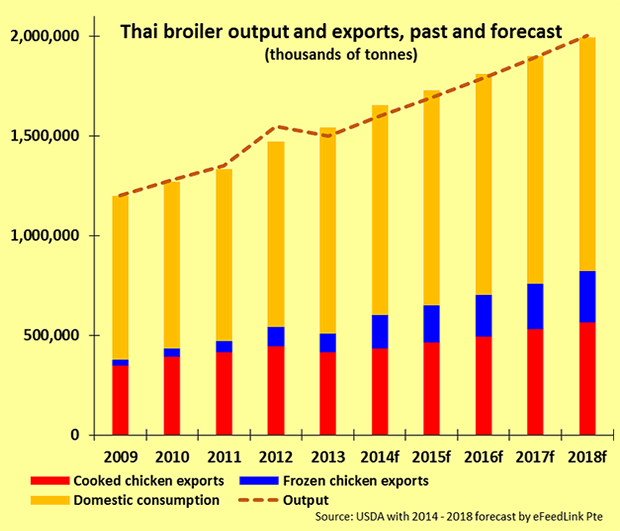
With the recent political coup not denting domestic consumption as much as feared and exports taking off, the broiler sector is poised to enjoy some of its best growth in nearly two decades. Although Saha Farm's feed-cost induced bankruptcy pulled 2013's production down 3% to 1.5 million tonnes, Business Monitor International estimates that from now to 2018, production will grow at 5.8% annual rate, exceeding 2 million tonnes in 2018. Although Thailand's integrators are among the most technically advanced and its domestic market the most mature in Asia, this growth rate matches that of less mature, lower per capita poultry consumption countries such as China or Vietnam.
At this time, Thailand has highly integrated, three part broiler sector. Approximately 70% of broiler meat output is accounted for integrated commercial farms owned by conglomerates such as CP or Betagro. Featuring climate controlled, compartmentalized, biosecurity centered poultry housings and separate quarters containing antibiotic-free for export to Europe broilers, this face that Thai agribusiness projects to the world.
Although the country has now been exporting chicken for decades, the structure is vastly changed from pre-2004 bird flu days, when contract farming provided a large proportion of integrators' output. With bird flu blocking fresh chicken exports to the EU and Japan for eight years, integration was extended beyond basic slaughtering and processing into cooked chicken and frozen, ready-to-eat meals. While the latter is shipped around the world (and outweighed raw chicken meat exports 4:1 in 2013), Britain and Japan accounted for 70% of 2013's cooked meat shipments.
Another 20% of poultry is done by large-scale commercial broiler farms. Though their biosecurity measures are strong compared to those of traditional western poultry farms, they are only moderate compared to those of export-oriented, integrator rivals. Once part of integrators' contract farming models, bird flu made the latter internalize most of their production. This has made commercial farms more domestically oriented. Along with rising farm scale, it has resulted in a merger or closure of many smaller operations: Thailand's department of livestock development estimates that the number of such commercial farms fell from 8,030 in 2008 to approximately 5,500 by the end of this year.
As usually happens in these cases, fewer farms usually comes with the expansion of scale economies and department of livestock figures also confirm this trend. With the number of broilers rising from 101 million in 2008 to an approximately 250 million this year, the number of broilers per farm increased from 12,683 in 2008 to around 40,000 this year. Going forward, with most new capacity investments being made by its top five integrators, we can expect their proportion of broiler output and farm scale to rise further.
Even bad news is working to its advantage: The country's political crisis had pulled down the value of the Thai baht (and its overseas chicken price) approximately 9% since the middle of last year. With lower feed costs reducing production expenses more in Thailand than in Brazil, these trends have further enhanced its competitiveness. This is especially true in the labor-intensive, cooked chicken export segment.
In fact, the USDA's 2014 forecast for production to rise 6.7% to 1.60 million tonnes is on the low side, with some private forecasts projecting increases as high as 8% and 1.8 million tonnes.
Aquaculture woes: Both fated and man-made
But while the poultry sector has not been this fortunate in years, aquaculture is in crisis. This can be seen in supermarkets from Europe to Southeast Asia, where early mortality syndrome (EMS) caused displays of frozen Thai shrimp to be replaced by their Vietnamese, Indian and Indonesian competitors.
Although it produces other species including tilapia, crabs and oysters, shrimp is by far Thailand's biggest export earner. 2013 saw production crash to 250,000 tonnes, from the previous year's 500,000 tonnes. The most optimistic estimates for 2014's shrimp production place it at 300,000 tonnes or less.
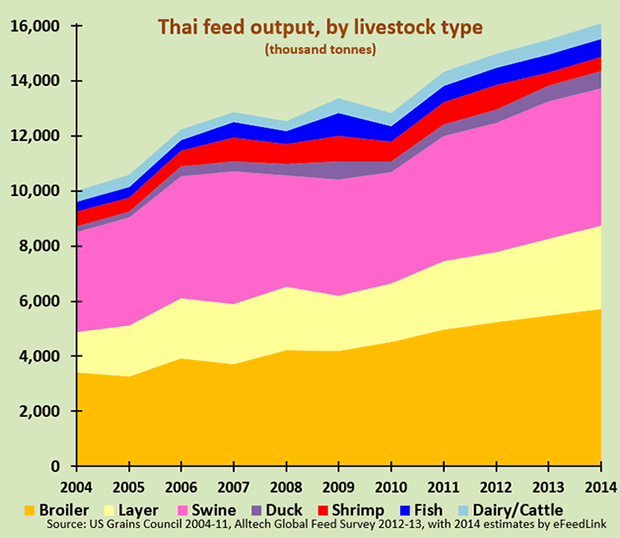
Previously, from 2004 to 2012, aqua feed consumption had been rising at a 7.4% annual rate. On the other hand, 2013's 15.5 million tonne feed output came in below the initially expected 16 million tonnes.
With half its shrimp output disappearing, so did Thailand's exports of this seafood line. From being the traditional number one shrimp exporter to the United States, Thai shrimp exports fell 40%, from 30,000 tonnes in 2012 to 17,904 tonnes in 2013. Formerly America's top shrimp supplier, its exports now trail those of India, Ecuador, Vietnam and India.
Moreover, even worse news arrived in mid June, when British newspaper The Guardian published an expose alleging that suppliers of large Thai aquaculture producers like CP and TUF employee subcontractors that keep captive unpaid slave labourers. Although they did their best to distance themselves from slavery allegations, and countered that they were unaware of such abuses, the damage was swift and immediate.
The article stated that, "A six-month investigation has established that large numbers of men bought and sold like animals and held against their will on fishing boats off Thailand are integral to the production of prawns (commonly called shrimp in the US) sold in leading supermarkets around the world."
It added that, "Men who have managed to escape from boats supplying CP Foods and other companies like it told the Guardian of horrific conditions, including 20-hour shifts, regular beatings, torture and execution-style killings…some were regularly offered methamphetamines to keep them going. Some had seen fellow slaves murdered in front of them."
Citing earlier warnings to control alleged slavery and human trafficking, the US government swiftly gave Thailand its lowest level 3 rating under its Victims of Trafficking and Violence Protection Act.
Leading western supermarkets such as America's Whole Foods, France-based Carrefour and Britain's Tesco immediately ceasing all imports of Thai shrimp. At this early stage of this latest scandal, whether governments erect trade barriers to Thai shrimp is actually irrelevant: The public relations disaster of forced slave labour is making large western importers distance themselves from it.
Even if this scandal never happened, the fact that is that shrimp exports are still two years away from equaling their pre-EMS volumes. During the intervening time, the quantity of shrimp exported by new producers will continue to boom, further diminishing its market share.
Prior to EMS and slave labour exposure, Thai aquaculture was having trouble competing against the low wages of neighbouring Southeast Asian countries. On the other hand, in everything from reducing its reliance on antibiotics to its more hygienic, capital-intensive supply chain, Thailand at least had a reputation for having a cleaner, more trustworthy aquaculture industry.
While EMS destroyed the quantity of shrimp available, the slave labour scandal is causing great damage to the reputation and perceived quality of its seafood exports.
Hence, no sooner did it recover from a decade of lost broiler output only to find its aquaculture line suddenly besieged by a combination of misfortune and man-made curses. To fully leverage its technological and marketing advantages over other countries, Thai aquaculture must undertake the same painful, thorough restructuring of its industry structure, work practices and industry structure that its broiler sector did a decade earlier.
All rights reserved. No part of the report may be reproduced without permission from eFeedLink.


