


June 19, 2013
Vietnam's impending feed crop import binge
Feed wheat is becoming scarce, meat consumption is outracing crop yields and soy crushing capacity cannot keep up.
by Eric J. BROOKS
An eFeedLink Exclusive Commentary
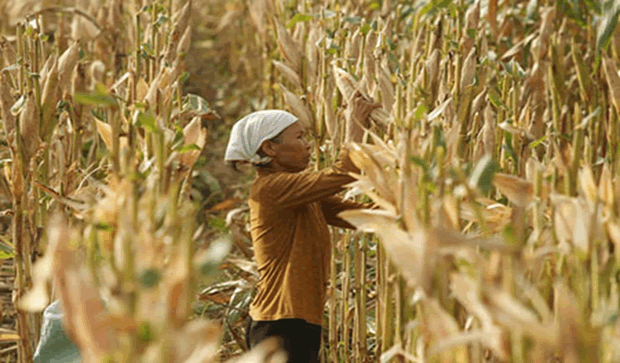
Few countries have seen their feed demand growing faster than Vietnam, where it increased at a greater than 10% pace for most of the previous decade. 2012 was no exception: 15.5 million tonnes of commercial feed was produced, of which livestock feed was 12.7 million tonnes and aqua feed 2.8 million tonnes. Although observers expected its feed consumption growth to slow down slightly, livestock feed demand jumped 10.4% in 2012.
 With personal incomes low but rising rapidly, there remains momentum for another decade of double digit increases in annual feed demand. Moreover, with only 56% of livestock feed being commercial produced. As Vietnamese livestock farming consolidates and starts using better quality commercial feed with corn and soy being put in place of traditional backyard farm scraps or crop residues. This means that even as feed output grows by 10% annually, demand for feed grains and protein meals can increase by several percentage points more. Needless to say, this makes it very likely that no matter how rapidly crop yields grow, supplies will lag the jump in feed demand.
Coinciding with a series of disappointing corn and soy harvests, demand growth is causing feed crop imports to race ahead of expectations. From January to May of this year, Vietnam's ministry of agriculture and rural development reports that feed imports cost 40.6% more than a year ago. With average corn and soy costs about 22% higher than a year earlier over this time, this implies that import volumes are growing at an annual rate near 20%. But even as they do so, various feed grains and oilseeds are constantly restructuring their relative proportions in response to their relative prices, supply availability and domestic processing capacity.
From corn to wheat & back to corn
For example, at the turn of the decade, corn did an exceptionally rare market move of becoming more expensive than wheat. This occurred as rainy weather degraded a large proportion of successive Australian harvests to feed wheat grade. The opportunity to import feed wheat also coincided with Chinese demand for domestic Vietnamese cassava and rice bran making these two alternative feed ingredients too expensive to be economically used.
With Australia supplying well over 90% of all wheat imports, feed wheat, rose from 0.15 million tonnes or 11% of all wheat imports in 2008-09 s to 1.30 million tonnes and 49% of all wheat imported corn imports in 2011-12. Even though corn imports initially shot up from 600,000 tonnes in 2007-08 to 1.48 million tonnes in 2008-09, the inflow of Australian feed wheat undercut its expected import growth.
 Traditionally used by Vietnamese only as an aqua feed binder, feed wheat's low price caused Vietnam's farmers to add the appropriate enzymes and for the first time, feed wheat to livestock. Hence, in 2008-09's feed wheat imports totaled just 10% of corn imports. However, by 2011-12, feed wheat amounted to 85% of the imported corn volume, with corn imports virtually no higher than they were in 2008-09.
But the tide turned in 2012-13, when a succession of poor wheat harvests in North America, Europe and Oceana put wheat back at its traditional price premium to corn. Moreover, with Australia's 2012-13 wheat exports their lowest since the late 1980s, Vietnam was forced to diversify its wheat imports.
Whereas in the H2 2011, 94% of its imported wheat came from Australia, in H2 2012, only 77% did, with Canada, the United States and India supplying most of the balance. In response to falling world inventories, as a percentage of total wheat imports, feed wheat fell from its 49% peak in 2011-12 to 41.7% in our current 2012-13 marketing year and an estimated 37% in 2013-14. As a proportion of corn import volumes, feed wheat fell from its 2011-12 peak of 85% to 63% this marketing year and 56% in 2012-13.
It must be said that these are conservative USDA estimates: After undercutting corn for two years, feed wheat equaled the cost of imported Indian corn in mid-2012 and became 15% more expensive from last September onwards. With corn's price having fallen sharply in recent months, wheat's proportion of total feed grain used may fall significantly below even these figures and corn import turn out higher than initially projected.
But one thing is for sure: Having gotten accustomed to including wheat in livestock feed, the high prices are making feed wheat usage fall back, but nowhere near its pre-2010 levels, when it accounted for about a tenth of corn imports and 10% of all imported wheat.
Flat yields, flat harvests imply imports
Behind the rapid growth in both corn and wheat imports is years of corn harvests that failed to meet expectations. At one point, Vietnam's government was projecting harvests in excess of 6 million tonnes by this time. But a succession of La Nina induced dry spell, unexpectedly poor improvements in crop yields and competition from crops like sugar cane have all kept corn harvests lower than was expected.
Instead of growing strongly as was projected, 2009-10's 5.28 million tonne harvest, no crop year produced even 5 million tonnes. In 2011-12, the USDA's 4.95 million tonnes estimate was undercut by the actual harvest size of 4.65 million tonnes. For 2012-13, the USDA's intial estimate of 5.3 million tonnes turned out to be just 4.80 million. At 4.82 million tonnes, the 2013-14 harvest is projected to be nominally identical in size to 2012-13's crop. Hence, the government's target of harvesting 7.5 million tonnes of corn by 2020 looks increasingly out of reach.
Indeed, after growing by 98.9% between 2002 and 2007, 2013's crop is only 4.4% larger than it was in 2007. From growing at an 18% annual pace, domestic corn production has inched upwards at barely 1% per year since 2007. With the amount of arable land that can be cultivated maxed out and unchanged at 1.2 million acres from the previous year, yields take much of the blame: From 1994 to 2004, corn yields doubled.
But in the nine years since 2004, yields increased by only 25%, which is the amount Vietnam's corn demand rises every 2.5 years. For 2013-14, the USDA expects yields to remain unchanged. This is the case even though at 51.5bushels/acre, Vietnam's corn yields are less than one third those of America's 160+bushels/acre.
Despite the flattening corn productivity, GM corn is still years away from being commercially available. At this time, 90% of corn planted is hybrid variety, of which 62% is imported from Thailand, 19% from Indonesia with only 19% domestically supplies. By the time GM corn becomes legally available, demand will have outraced yields for too long to restore feed grain self-sufficiency.
With feed grain demand continuing to rise at a near 10% annual pace and feed wheat becoming scarcer, all this implies that corn import growth will resume its strong, pre 2010 growth trend, when volumes more than doubled every five years. Hence, after five years when feed wheat availability kept corn imports between 1 million and 1.5 million tonnes, 2013-14's USDA projection is for a record 1.6 million tonnes, which is projected to rise by 12.5% to 1.8 million tonnes in 2013-14. But with feed demand rising so rapidly and feed wheat becoming increasingly less economical, it would not be surprising if 2013-14's corn imports jumped to 2.0 tonnes million instead, and up to 2.5 million tonnes in the next marketing year.
Vietnam usually sources about 70% to 75% of this corn from India, which undercuts both North and South America on both the corn price and its transport fees. Another 15% is usually sourced from Brazil and Argentina, with the rest mostly coming from Thailand Cambodia or Laos.
Crushing lags demand, soymeal makes comeback
Nor is meat demand crashing up against input restraints only for feed grain. The same is occurring with soy, where raw bean imports have risen but soymeal imports did not fall. Initially,
AT 1.29 million tonnes, 2012 soya bean imports were up 26% from 2011's 1.02 million tonnes, and they are projected to rise another 12.4% to 1.45 million tonnes in 2013 and by 6.9% to 1.55 million tonnes in 2013. The problem is that imports of raw soya beans are tapering off too quickly and represent a loss of value-added production.
Until two years ago, Vietnam met its protein needs mostly through importing soymeal, and the raw soya beans imported were mostly for meeting human consumption needs. However, in mid-2011, Bunge and Quang Minh Corporation (QMC) opened soy crushing plants. As a result, soymeal imports fell 18.1%, from 2.88 million tonnes in 2009-10 to 2.36 million tonnes in 2011-12.
With demand growing, both crushers ramped up capacity: Bunge crushed 0.9 million tonnes of soy in 2012 and intends to crush 1.0 million tonnes in 2013. QMC crushed 0.14 million tonnes of soy in 2012 and intends to crush 0.25 million tonnes in 2013.
But while domestic crushing capacity has been increased by 210,000 tonnes, domestic soya bean demand increased by 215,000 tonnes over the last year, and will rise by another 105,000 tonnes over the next marketing year. In all, since the plants opened in mid-2011, soy crushing capacity has lagged demand growth by close to 300,000 tonnes.
As a result, soymeal import, which declined with the opening of these crushing facilities, are now rising again, to approximately 2.5 million tonnes this year and slightly more in 2014. Capacity additions to existing facilities are unlikely to keep up with feed demand growth near 10%. As new plants take several years to build, this implies that soymeal imports should keep rising and exceed their previous high of 2.8 million tonnes in the late 2000s.
Soy imports are also driven by Vietnam's succession of disappointing soy harvests. First, with 2009's feed demand taking off by 9%, dry weather caused that year's soy production to slump to 214 thousand tonnes. That was a far from the national five-year plan's anticipated 325 thousand tonnes, or domestic demand of two million tonnes. It is also lower than the 267.6 thousand tonnes of soy harvested in 2008, when Vietnam's feed demand was about 40% lower than it is today.
Then 2011's wet weather kept that year's crop at 297,000 tonnes, well below initial government forecasts of 350,000 tonnes. Last year, unusually chilly weather in the country's north slashed the soy crop from the USDA expected 300,000 tonnes to just 175,000 tonnes, at a time when Vietnam's policymakers were shooting for twice that number. At this point, the USDA expects 270,000 tonnes of soy for this year and 300,000 in 2014.
Indeed, the Vietnamese government's goal of producing 750,000 tonnes of soy on 350,000 planted acres looks increasingly out of reach.
First, the government was hoping to have 350,000 planted acres by 2020 but from 2010 to 013, soy planted acreage actually fell by 9%, to 180,000 acres. This is because not only do competing crops such as sugarcane or corn offer higher returns, but domestic soy's costs approximately 15% more than imports, even though its unit production costs are relatively higher.
Second, for a 750,000 tonne soy to be achieved in 2020, not only did crop acreage need to expand but soy crop yields needed to reach 2 tonnes/hectare, which would imply a 33% increase in productivity or a 4% annual increase in soy yields over the next seven years. But in the 10 years from 2002 to 2012, soy crop yields only increased 12.4%, or at a mere 1.3% annual rate –and the growth rate actually tapered off over the last five years.
Hence, with soy, as with feed grain, large double digit increases in imports appear to be locked in for at least the next ten years. Crushing capacity expansion will determine exactly how much of that soy comes in the form of raw beans and how much will be imported as finished soymeal.
Already the fifth largest soymeal importer and ninth largest soya bean importer, there is no doubt that within 10 years, Vietnam's combined soya bean and soymeal imports will rival those of Japan or Mexico, and it will rank as the second or third largest soy importer in the world behind China.
Foreign feed, foreign ownership
But foreign participation in Vietnam's feed sector transcends mere feed imports. Of the 243 feed mills in Vietnam in 2012, 57 were foreign owned, and they accounted for 52% of feed output, with joint ventures between domestic Vietnamese feed mills and multinationals accounting for another 6% of production.
But 40 of Vietnam's 186 domestic feed mills closed last year, and another thirty are expected to go out of business this year, leaving the country with an estimated 106 domestic and 57 foreign feed mills by the end of this year. Within that large foreign cohort, several multinationals stand out: Thailand owned CP produces 18% of Vietnam's feed, while Cargill produces another 8% of this nation's feed.
And it should be noted that in all Asian markets they have set up shop, foreign mills and crushers have increased the proportion of imported feed materials in the agribusiness supply chain. With both corn and soy crop production falling ever further behind demand, backyard farms transitioning to professional feed ingredients and foreign firms eyeing cheaper feed grain and oil seed, Vietnam's feed crop imports will surprise many observers in the second half of this decade.
All rights reserved. No part of the report may be reproduced without permission from eFeedLink.


